
[eu + topos = good + place] the idyllic, harmonious, natural place that enchants you, where time has no meaning and you enjoy absolute serenity...


The parboiled rice & red lentils mix will amaze you, not just visually but mostly by its flavor! But what are red lentils? They are a variety of lentils with a sweeter and milder flavor compared to common lentils and are quite impressive due to their unique color. They contain insoluble fiber, which is easier to digest, especially for people that have dyspepsia to legumes or irritable bowel syndrome. Another advantage of red lentils is the high phosphorus content, which plays a pivotal role in the formation and development of teeth and bones, contributes to good eye health, and to the production of ATP, i.e. energy.
Red lentils contain protein, but they lack two necessary amino acids, which our organism can only take from food and cannot synthesize on its own. This hurdle can be overcome by bringing together a legume and a cerial, such as lentils with rice. This creates a dish with protein of high biological value, i.e., it contains the entire profile of amino acids necessary for the human organism.
Nutrition Declaration of 100g


Rice/liquid ratio

1 cup
of rice

2 cups
of water
Boiling time
Extra Tip
This is a choice with high nutritional value, especially beneficial for people who are fasting, for vegetarians, and for people who exercise regularly.
This mix brings together parboiled rice with Latin America! How do we do that? With black quinoa! Quinoa is one of the most widely known superfoods, that has been incorporated into our daily diet, enriching it nutritionally, adding color and unique flavor to our dishes. It is one of the very few plant products that contain all the amino acids necessary for the organism.
The high fiber content of black quinoa, combined with parboiled rice, helps ease problems of intestinal disfunction, and it can also be freely consumed by people with celiac disease since it is gluten-free.
Finally, black quinoa contains anthocyanins and phenolic compounds in greater concentrations compared to other forms of quinoa. These contribute to the elimination of free radicals, which are responsible for the destruction of cell membranes. So, there is no easier and more flavorful way to enjoy a uniquely antioxidant dish.
Nutrition Declaration of 100g


Rice/liquid ratio
1 cup
of rice
2 cups
of water
Boiling time
Extra Tip
Black quinoa, when cooked, becomes crunchier in texture. Combined with parboiled rice, it will create an explosion of texture and flavor in your mouth!
A dietary combination that will amaze you with its flavor. The combination of basmati rice with millet offers great nutritional value. Millet has its roots in antiquity; Pythagoraρύζιs cites it as the “ideal food”.
The nutritional value added to your plate with the simultaneous consumption of these two cereals is priceless. Millet enriches the rice with plant-derived iron, a vitally important metal for the organism, and it reinforces your dish with phosphorus and B-complex vitamins, which are necessary for the development of nerve cells, for brain function, for red blood cell production, and for the metabolism of macronutrient elements of food. Both cereals are gluten-free.
Nutrition Declaration of 100g


Rice/liquid ratio
1 cup
of rice
2 cups
of water
Boiling time
Extra Tip
Consuming Basmati rice together with millet is especially beneficial for people who exercise regularly and seek plant-based protein sources to support their muscle mass.

White, long-grain rice. It is grown in India and Pakistan, in regions around the rivers that spring from the Himalayas. It has a distinct aroma that is due to the soil of the regions where it is grown. It is no accident that the word Basmati means “fragrant”.
Ideal to accompany exotic dishes with Asian sauces or served plain as pilaf.
Nutrition Declaration of 100g
Rice/liquid ratio
1 cup
of rice
2 cups
of water
Boiling time
Extra Tip
Basmati is considered more healthy than other rice cultivars, because its consumption does not lead to an abrupt increase in blood sugar levels.
White, long-grain rice. It is grown on the plateaus of Thailand, in specially configured rice fields (tiered terraces). It gets its spectacular natural aroma from the soil of the regions where it is grown. That is why it is named after jasmine!
It is the perfect accompaniment for oriental, spicy, and generally exotic dishes.
Nutrition Declaration of 100g
Rice/liquid ratio
1 cup
of rice
2 cups
of water
Boiling time
Extra Tip
Jasmine rice is gaining more and more admirers, and its consumption in Greece has grown significantly in recent years.

White and medium-grained, Glacéis one of the oldest grown cultivars. It is grown in many regions of Greece, with the largest production in Halastra, Thessaloniki.
The grains in this variety tend to become sticky when cooked, making glacé rice ideally suited for soups, Greek “gemista” (tomatoes and peppers stuffed with rice), and rice pudding. In regard to gemista, opinions differ – some people prefer Carolina rice. Try them with both varieties to see which one is closer to your preferences.
Nutrition Declaration of 100g
Rice/liquid ratio
1 cup
of rice
2,5 cups
of water
Boiling time
Extra Tip
We use Glacé rice in soups for a thicker and delicious outcome.
Carolina rice is the best-known cultivar in Greece. It is grown mostly in Central Macedonia and specifically in the Axios river estuary, and in Serres near the Strymonas river.
It is a medium-grained rice which, after being harvested, is processed and whitened in order to acquire its distinctive white color.
Its ability to soak in fat makes Carolina rice an excellent choice to make pilaf, or as a side to oven-baked dishes. It is suitable for many traditional Greek recipes, such as dolmades yalantzi (stuffed grape leaves), stuffed tomatoes and peppers, rice with mussels and the perfect risotto.
Nutrition Declaration of 100g
Rice/liquid ratio
1 cup
of rice
2,5 cups
of water
Boiling time
Extra Tip
Pilaf must be served hot, immediately after being cooked.
It is derived from long-grained rice cultivars and owes its distinctive yellowish color to hydrothermal processing. The grain is pre-boiled to remove the hull, and then it is boiled again. This process keeps its nutrients intact.
It is preferred by a majority of consumers because, due to its special processing, the grains do not stick together and it remains fluffy, making it ideal as a garnish for many beloved dishes, such as beef in red sauce, rice salad, smyrneika soutzoukakia (meatballs with red sauce), and Corfu-style sofrito.
Nutrition Declaration of 100g
Rice/liquid ratio
1 cup
of rice
2,5 cups
of water
Boiling time
Extra Tip
If pilaf is not consumed right away, cover it with a towel and close the lid, in order to trap the steam and avoid the rice going soft.
White, long-grained rice, it is traditionally grown in the region of Halastra, Thessaloniki. It has a low starch content, making the grains of this cultivar much harder than other varieties.
Due to its shape (long and narrow), Nychaki is ideal for pilaf and for stuffing. If you prefer your pilaf more al dente, Nychaki is the perfect choice for you.
Nutrition Declaration of 100g
Rice/liquid ratio
1 cup
of rice
2 cups
of water
Boiling time
Extra Tip
Because Nychaki rice needs a lot of humidity to cook properly, cook it in boiling liquid or steam it.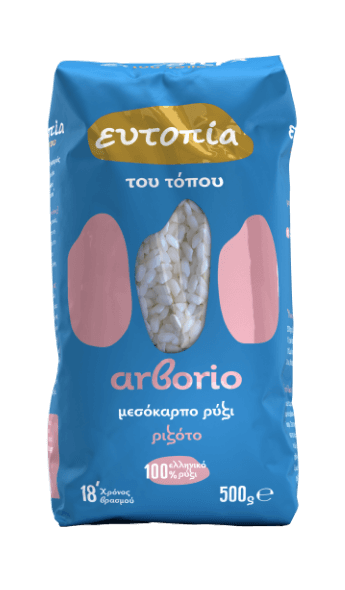
The Authentic Taste of Premium Rice
Discover our new product, Eutopia tou Topou – Arborio, a top-quality rice that stands out for its rich texture and creamy consistency when cooked. Carefully cultivated with passion and respect for the land, our Arborio rice comes from fertile Greek fields, where ideal conditions give it a unique character.
Thanks to its high amylopectin content, Eutopia tou Topou – Arborio is the perfect choice for risotto, as it gradually absorbs liquids and gives dishes a velvety texture. Whether you’re preparing a classic Italian risotto or a creative dish, this rice will elevate both the taste and quality of your meal.
Indulge in the authentic flavor and exceptional quality of Arborio rice and enjoy a product that honors the traditions of our land.
Nutrition Declaration of 100g
Rice/liquid ratio
1 cup
of rice
2,5 cups
of water
Boiling time
Extra Tip
Cook the risotto over medium heat, stirring constantly to release the starch and achieve a velvety texture!We respect local traditions and the precious characteristics of the Greek soil. Our products’ journey begins at the Axios river estuary and they reach consumers under the strictest quality and safety standards, with their high nutritional value intact.
White and medium-grained, Glacéis one of the oldest grown cultivars. It is grown in many regions of Greece, with the largest production in Halastra, Thessaloniki.
The grains in this variety tend to become sticky when cooked, making glacé rice ideally suited for soups, Greek “gemista” (tomatoes and peppers stuffed with rice), and rice pudding. In regard to gemista, opinions differ – some people prefer Carolina rice. Try them with both varieties to see which one is closer to your preferences.
Energy: 1443 kj
340 kcal
Fat
of which saturates: 1 g
0 g
Carbohydrates
of which sugars: 74.1 g
< 0.5 g
Protein: 8.7 g
Salt: 0 g
1 cup
of rice
2,5 cups
of water
18 - 20 minutes
Carolina rice is the best-known cultivar in Greece. It is grown mostly in Central Macedonia and specifically in the Axios river estuary, and in Serres near the Strymonas river.
It is a medium-grained rice which, after being harvested, is processed and whitened in order to acquire its distinctive white color.
Its ability to soak in fat makes Carolina rice an excellent choice to make pilaf, or as a side to oven-baked dishes. It is suitable for many traditional Greek recipes, such as dolmades yalantzi (stuffed grape leaves), stuffed tomatoes and peppers, rice with mussels and the perfect risotto.
Energy: 1443 kj
340 kcal
Fat
of which saturates: 1 g
0 g
Carbohydrates
of which sugars: 74.1 g
< 0.5 g
Protein: 8.7 g
Salt: 0 g
1 cup
of rice
2,5 cups
of water
18 - 20 minutes
It is derived from long-grained rice cultivars and owes its distinctive yellowish color to hydrothermal processing. The grain is pre-boiled to remove the hull, and then it is boiled again. This process keeps its nutrients intact.
It is preferred by a majority of consumers because, due to its special processing, the grains do not stick together and it remains fluffy, making it ideal as a garnish for many beloved dishes, such as beef in red sauce, rice salad, smyrneika soutzoukakia (meatballs with red sauce), and Corfu-style sofrito.
Energy: 1443 kj
340 kcal
Fat
of which saturates: 1 g
0 g
Carbohydrates
of which sugars: 74.1 g
< 0.5 g
Protein: 8.7 g
Salt: 0 g
1 cup
of rice
2,5 cups
of water
18 - 20 minutes
White, long-grained rice, it is traditionally grown in the region of Halastra, Thessaloniki. It has a low starch content, making the grains of this cultivar much harder than other varieties.
Due to its shape (long and narrow), Nychaki is ideal for pilaf and for stuffing. If you prefer your pilaf more al dente, Nychaki is the perfect choice for you.
Energy: 1443 kj
340 kcal
Fat
of which saturates: 1 g
0 g
Carbohydrates
of which sugars: 74.1 g
< 0.5 g
Protein: 8.7 g
Salt: 0 g
1 cup
of rice
2,5 cups
of water
18 - 20 minutes
The Authentic Taste of Premium Rice
Discover our new product, Eutopia tou Topou – Arborio, a top-quality rice that stands out for its rich texture and creamy consistency when cooked. Carefully cultivated with passion and respect for the land, our Arborio rice comes from fertile Greek fields, where ideal conditions give it a unique character.
Thanks to its high amylopectin content, Eutopia tou Topou – Arborio is the perfect choice for risotto, as it gradually absorbs liquids and gives dishes a velvety texture. Whether you’re preparing a classic Italian risotto or a creative dish, this rice will elevate both the taste and quality of your meal.
Indulge in the authentic flavor and exceptional quality of Arborio rice and enjoy a product that honors the traditions of our land.
Energy: 1443 kj
340 kcal
Fat
of which saturates: 1 g
0 g
Carbohydrates
of which sugars: 74.1 g
< 0.5 g
Protein: 8.7 g
Salt: 0 g
1 cup
of rice
2,5 cups
of water
18 - 20 minutes

"Hippocrates"